They taught me a song
when I was too young
to question the lyrics.
Told me to stand straight,
hand over heart,
eyes on the flag,
and sing about a land
where freedom lived.
Land of the free.
Home of the brave.
But somewhere between
the anthem
and the ambulance bill,
between the pledge
and the eviction notice,
between liberty and justice for all
and insufficient funds—
I started hearing
a different song.
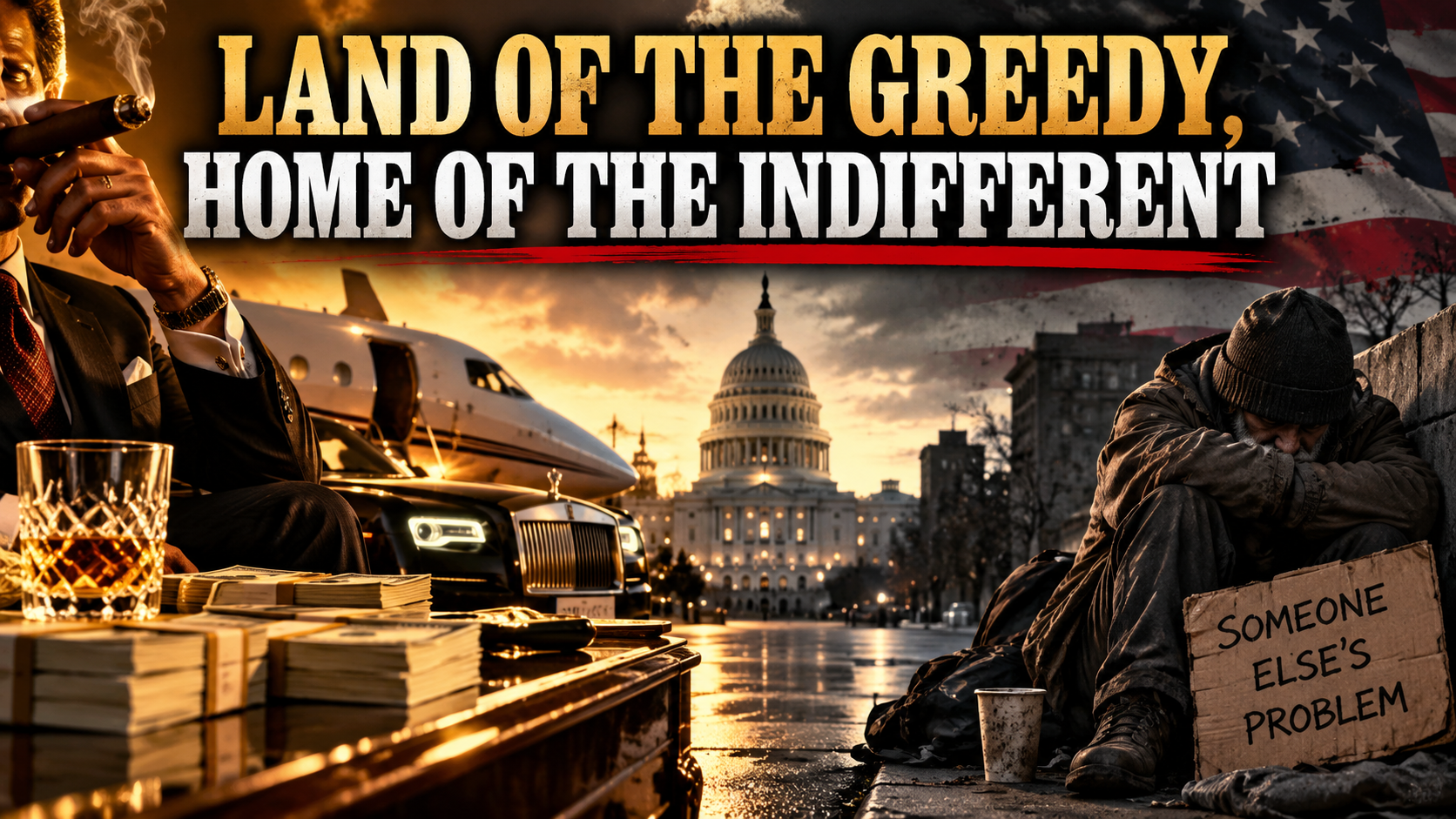
Land of the greedy.
Home of the indifferent.
Where a man can work
forty hours,
then forty more,
and still choose between
medicine
and groceries.
Where a mother counts pennies
under a kitchen light
while someone in a tower
counts profits
and calls them both
the economy.
Where children learn
that lunch has a price,
education has a price,
health has a price,
shelter has a price—
and dignity?
Apparently,
that has a price too.
We have enough food
to throw it away,
but not enough compassion
to make sure everyone eats.
Enough empty buildings
to watch people sleep
beneath bridges.
Enough medicine
to perform miracles,
but sometimes the miracle
depends upon
what your insurance card says.
And we call this
civilization.
We walk past suffering
because we have appointments.
Scroll past tragedy
because the next video
is only a thumb away.
Watch someone else’s world collapse
through six inches of glass,
shake our heads,
type,
“Prayers.”
Then keep scrolling.
Indifference
has become convenient.
We don’t have to hate you.
That’s the genius of it.
We only have to decide
that your suffering
is none of our business.
The hungry?
Someone else’s problem.
The homeless?
Someone else’s problem.
The elderly choosing
between electricity
and prescriptions?
Someone else’s problem.
The veteran sleeping beneath
the flag he once served?
Someone else’s problem.
The child born into a neighborhood
where opportunity packed its bags
generations ago?
Someone else’s problem.
Until one day—
we become
someone else’s problem.
That’s the part
the greedy never tell you.
The machine doesn’t love them either.
It loves appetite.
More.
More land.
More money.
More power.
More profit.
More zeros
behind numbers
no human being
could spend in ten lifetimes.
And still—
more.
How much is enough?
How many houses
can one person sleep in?
How many meals
can one stomach eat?
How many billions
does it take
before a man finally says,
I have enough.
Let somebody else breathe.
Maybe greed isn’t wanting more.
Maybe greed is having more
than you could ever need
and still believing
someone with nothing
is asking for too much.
We built monuments
to generosity
while constructing systems
that reward selfishness.
We quote scripture
with diamonds around our necks
and step over Lazarus
on the sidewalk.
We praise charity
because charity asks nothing
about justice.
Charity says,
Here is a sandwich.
Justice asks,
Why were you hungry
in the first place?
And that question
makes powerful people nervous.
So they teach us
to blame downward.
The poor blame the poorer.
The worker blames the immigrant.
The struggling family blames
another struggling family.
Everybody fighting
over crumbs
while somebody quietly
walks away
with the bakery.
And somewhere
a bell rings.
A flag waves.
An anthem begins.
O say can you see…
Yes.
I can see.
That’s the problem.
I can see the tents
beneath the skyscrapers.
I can see the food banks
beside luxury markets.
I can see teachers
buying classroom supplies
from their own pockets.
I can see working people
one emergency away
from losing everything.
I can see abundance.
And I can see suffering
standing directly beside it.
So don’t tell me
we don’t have enough.
Tell me the truth.
Tell me we decided
who deserves enough.
Because poverty
in the presence of abundance
is not simply scarcity.
Sometimes—
it is a choice.
And indifference?
Indifference is how
the rest of us
learn to live with that choice.
But I refuse.
I refuse to believe
this is the best
we can become.
I refuse to accept
that compassion is weakness,
that generosity is foolishness,
that another person’s suffering
has nothing to do with me.
Because there is another anthem
waiting to be written.
One where success
is not measured
by how high we climb,
but by how many hands
we reach back for.
Where nobody has to lose
for somebody else to win.
Where enough
finally means—
enough.
Maybe then
we can stand together,
hands over hearts,
not because someone
told us to,
but because the words
finally became true.
Until then,
I will not confuse
wealth
with greatness.
I will not confuse
power
with virtue.
And I will never confuse
indifference
with freedom.
Because a nation
cannot call itself free
while compassion
is held hostage
by profit.
And no country
can truly call itself home
until the people
nobody wants to see
can finally say—
There is a place
for me here, too.
Leave a Reply