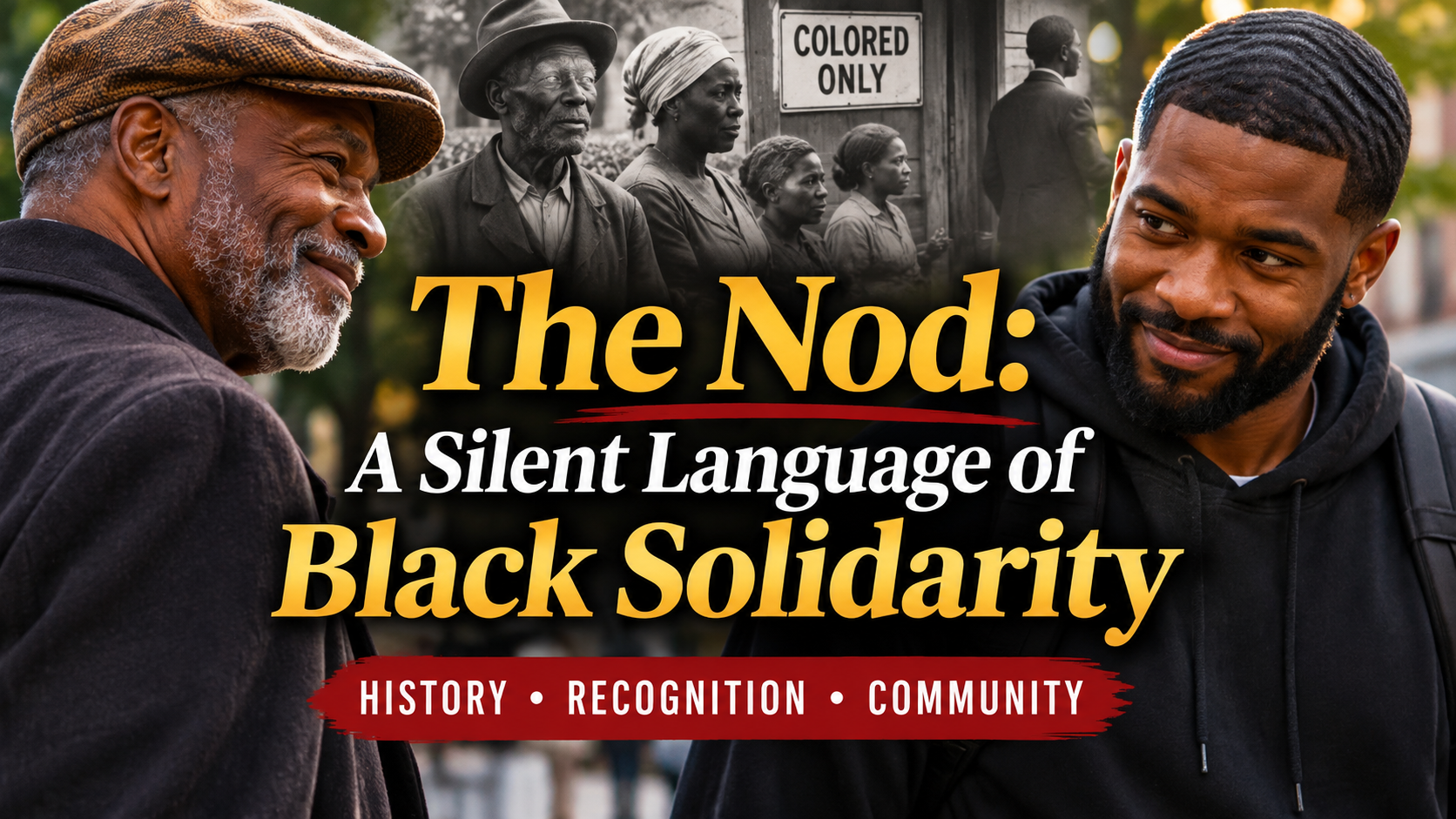
Sometimes the most powerful conversations are the ones in which not a single word is spoken.
By Melvin L. Wilcox
There is something that happens between Black people, particularly Black men, that often goes unnoticed by the rest of the world.
Two strangers pass each other on a sidewalk. Their eyes meet for a brief moment. One slightly raises his chin. The other responds with a subtle downward nod.
No words are exchanged.
No introductions are necessary.
They may never see each other again.
Yet, in that fleeting moment, something has been acknowledged.
I see you.
You see me.
We understand something about each other that requires no explanation.
It is what many of us simply call the nod.
But I believe it is much more than a greeting.
It is a quiet expression of a shared experience, a cultural inheritance, and perhaps one of the simplest demonstrations of solidarity that has survived generations of struggle.
A Language Born of Necessity
To understand the significance of the nod, we must look beyond the gesture itself and consider the history of the people who practice it.
For centuries, Black people in America lived in a society that systematically denied their humanity.
During slavery, our ancestors were treated as property. Families were separated, names were taken, languages were suppressed, and even the simplest expressions of independence could carry terrible consequences.
Emancipation did not immediately bring safety.
The years following the Civil War introduced new forms of oppression. Black Codes, racial terror, segregation, and Jim Crow laws reminded Black Americans that freedom on paper did not necessarily mean freedom in practice.
In such a world, recognizing another Black person could carry a significance beyond ordinary courtesy.
A familiar face could mean assistance.
A sympathetic stranger could mean protection.
A quiet acknowledgment could offer reassurance in an environment where danger was never far away.
We cannot say with certainty that today’s familiar head nod originated in one particular period of history. But the tradition fits within a much broader history of Black Americans developing ways to communicate recognition, community, and mutual support.
Sometimes solidarity was expressed through churches, mutual aid societies, and community organizations.
Sometimes it was expressed through a helping hand.
And sometimes, perhaps, it was as simple as looking another person in the eye and acknowledging that they were not alone.
Growing Up When a Greeting Meant Something
I grew up in St. Augustine, Florida, during the Jim Crow era.
I remember a time when signs reading “Colored Only” were not relics in a museum. They were part of the world around us.
Segregation was not something we studied in history books.
It was something we lived.
As a child, I did not fully understand the complicated machinery of racial discrimination. But I understood that there were places we could go and places we could not. There were rules that applied to us differently, and there were dangers that adults understood even when children did not.
I also grew up in a community where acknowledging one another was part of everyday life.
A greeting was more than good manners.
It was a recognition of another person’s presence and dignity.
When an older Black man greeted a younger one, there was often a sense of respect being passed between generations.
When two Black men crossed paths and exchanged a nod, neither needed to explain his life story to the other.
There was an unspoken understanding that both existed in a world where the color of their skin could influence how they were treated.
They might have been strangers.
But they were not entirely unknown to one another.
And perhaps that is what makes the nod so remarkable.
It acknowledges a connection without demanding a relationship.
The Universal Language of “I See You”
The nod is not limited to Black men.
Black women have their own expressions of recognition, often through a smile, a knowing glance, a greeting, or a brief exchange that carries more meaning than the words themselves.
Sometimes it is a simple “Hey, baby.”
Sometimes it is “How you doing, sister?”
Sometimes it is a smile exchanged between two Black women in a room where neither sees many faces that look like her own.
And sometimes it is a glance that says, Girl, did you just see what I saw?
The forms may differ, but the underlying message can be the same.
We recognize one another.
Consider a Black person entering a room filled with hundreds of people and discovering only one other Black face.
There may be no conversation.
There may be no shared background, profession, or personal interest.
But when their eyes meet, a smile or nod may pass between them.
Why?
Because recognition can be comforting when you are accustomed to being overlooked.
It is a reminder that, even in unfamiliar surroundings, someone else may understand an experience you have not yet spoken aloud.
The Difference Between Being Seen and Being Recognized
There is a difference between someone looking at you and someone acknowledging you.
Throughout American history, Black people have often been highly visible while simultaneously being denied recognition as full and equal human beings.
We were visible when labor was needed.
Visible when blame was assigned.
Visible when suspicion was directed toward us.
But too often invisible when dignity, opportunity, compassion, and justice were being distributed.
Perhaps that is one reason a simple acknowledgment can carry such emotional weight.
The nod says:
I recognize your humanity.
I acknowledge your presence.
You do not have to prove that you belong in this moment.
There is no paperwork to complete.
No credentials to present.
No social standing to establish.
Just one human being acknowledging another.
And in a society that has so often measured Black worth against standards imposed by others, that simple act can be quietly revolutionary.
But Have We Forgotten What the Nod Represents?
This is where I believe the conversation must become more uncomfortable.
We have inherited gestures of solidarity.
But have we preserved the responsibilities that should accompany them?
We nod to one another on the sidewalk, yet sometimes fail to support one another in the marketplace.
We greet one another as brothers and sisters, yet too often allow differences in income, education, religion, politics, or social status to divide us.
We celebrate Black excellence when it becomes famous, but how often do we encourage it when it is still struggling to survive?
We speak passionately about unity, but do we practice it when unity requires patience, sacrifice, honesty, or forgiveness?
A nod costs nothing.
True solidarity sometimes costs us something.
It may require us to mentor a young person who has nothing to offer in return.
It may require us to support a Black-owned business while also holding that business accountable to the same standards of integrity we expect from everyone else.
It may require us to put aside personal differences for the benefit of a larger community.
It may require us to recognize that another Black person’s success does not diminish our own.
And sometimes it requires us to confront uncomfortable truths about how we treat one another.
What good is acknowledging a brother in passing if we refuse to acknowledge his humanity when he needs our help?
What good is calling someone sister if we turn our backs when she struggles?
The nod should not be the conclusion of our solidarity.
It should be the beginning.
The Ancestors Left Us More Than a Gesture
Our ancestors did not endure centuries of oppression merely so future generations could exchange greetings.
They built families when the law refused to protect them.
They established churches, schools, businesses, and communities when institutions excluded them.
They created systems of mutual assistance because they understood that survival often depended upon collective responsibility.
They understood something we sometimes forget:
A community is not made strong simply because its members share an identity. It becomes strong when its members share a commitment to one another.
That is the inheritance I believe we must recover.
Not simply the acknowledgment.
But the obligation behind it.
The understanding that when one of us rises, we have an opportunity to reach back and help another rise.
That our children’s futures should matter beyond the walls of our own homes.
That our elders deserve more than ceremonial respect.
That our history should be more than something we remember during Black History Month.
And that unity should be something we build, not merely something we proclaim.
From the Sidewalk to the Future
In writing The Return Chronicles, I have spent considerable time exploring what happens when people separated by centuries of history begin rediscovering their connections to one another.
The central question is not simply whether the African diaspora can return to the land of its ancestors.
The deeper question is whether we can recover the sense of collective responsibility necessary to build a shared future.
Because geography alone cannot create unity.
Neither can ancestry.
Neither can a common skin color.
Unity requires intention.
It requires trust.
It requires an understanding that we are individuals with different experiences, perspectives, and ambitions, yet we can still recognize the value of working together.
In many ways, that is what the nod represents to me.
Two people who may have nothing else in common choosing, for one brief moment, to acknowledge a connection.
Imagine what might happen if we carried that same spirit beyond the sidewalk.
Into our businesses.
Into our schools.
Into our neighborhoods.
Into our families.
Across the oceans that separate the African continent from its diaspora.
Imagine if the simple recognition of I see you became the deeper commitment of I will not pretend your future has nothing to do with mine.
That would be more than a cultural tradition.
That would be the foundation of something extraordinary.
The Next Time You Give the Nod
The next time you pass another Black person and exchange that familiar gesture, consider what it represents.
Think about the generations who came before us.
Those who endured slavery.
Those who survived Jim Crow.
Those who marched, organized, sacrificed, and struggled to secure freedoms that many of us now take for granted.
Think about the communities they built and the responsibilities they passed forward.
And remember that a gesture of recognition, however small, can remind us of something much larger.
We are not required to agree on everything.
We are not required to share the same beliefs, ambitions, or experiences.
And we should never assume that every Black person sees the world in exactly the same way.
But we can choose to recognize one another’s dignity.
We can choose to respect one another’s humanity.
And we can choose to turn acknowledgment into action.
Because the true measure of our solidarity is not how readily we greet one another.
It is how faithfully we stand beside one another when the greeting is over.
So the next time our paths cross, and I give you that familiar nod, understand what I hope it means.
I see you.
I recognize you.
Your humanity matters.
And if the day ever comes when you need a hand rather than a nod, I hope I will have the courage and compassion to extend it.
Because our ancestors left us something far greater than a silent greeting.
They left us one another.
And perhaps the greatest tribute we can pay them is to remember what that means.
One Race. One People. One Destiny.
Melvin L. Wilcox
Author of The Return Chronicles and Voices of the Diaspora
Ancestral Lens Productions
Leave a Reply